

The Development Trends series highlights areas where investment is occurring around transit lines to show how transit can tie together housing, jobs, shopping, and more.
The Development Trends reports are annual reports that identify projects that add more than $1 million in building value over a one-year period along the 22 TOD corridors in Cuyahoga County. These reports serve to show trends in TOD investment in Cuyahoga County.
2026 Edition: Development Trends on TOD Corridors
The 2026 Edition of the Development Trends on TOD Corridors report looks at data between 2019 and 2025. Each development within Cuyahoga County that had more than $1 million in added building value in 2025 was analyzed to determine whether they conform to criteria for transit-oriented design. These criteria include the following: TOD must be multiple stories, close to the street, parking located to the rear or side, a TOD-friendly use or mix of uses, and a front-facing building entrance.
Since 2019, Cuyahoga County has seen 122 new TOD projects, including new construction and redeveloping existing buildings into TOD-friendly uses. Data shows that new investments in TOD are increasing with 2025 having the most TOD investment ($324 million) since 2019.
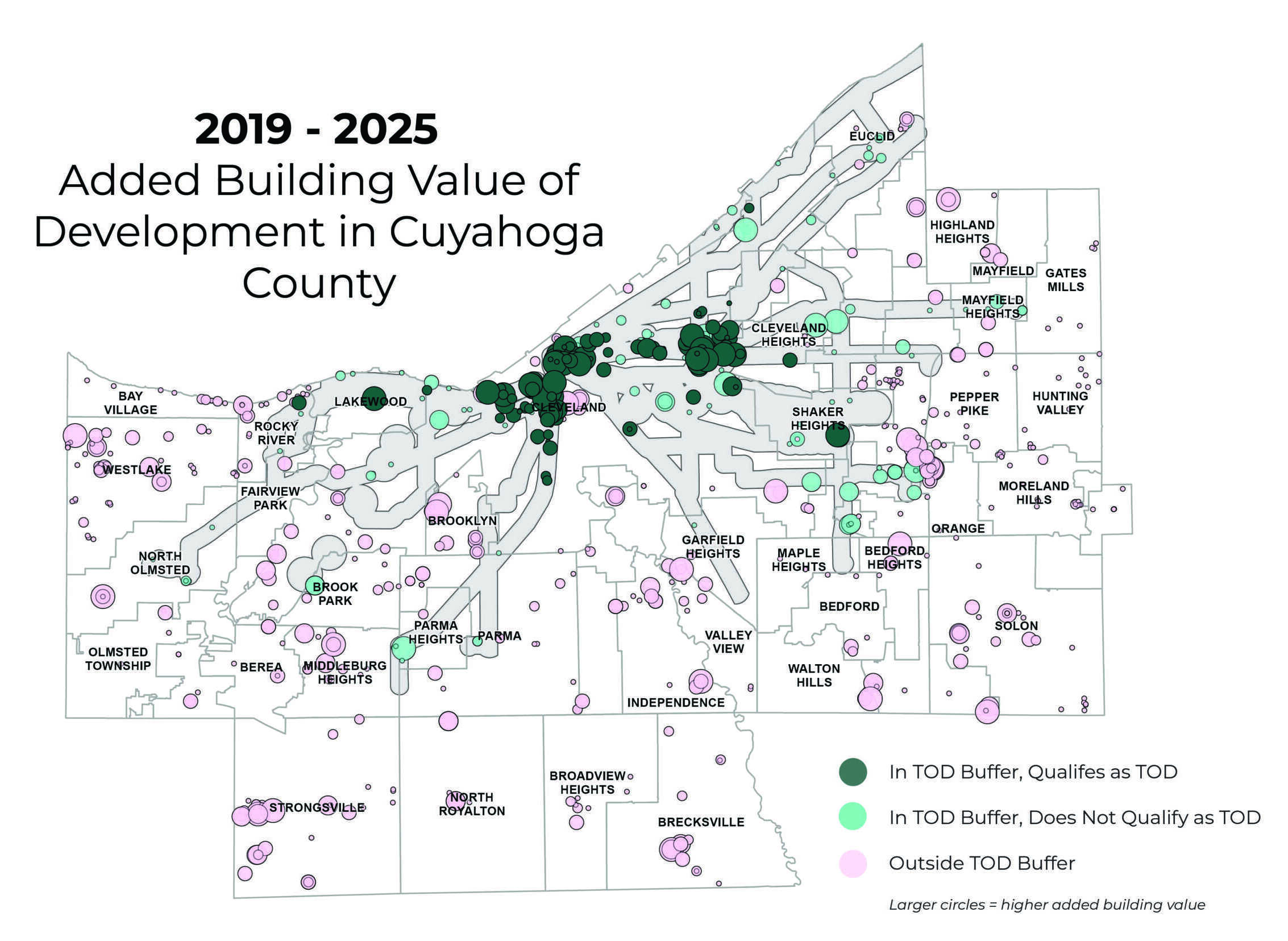
Core findings from the report include:
- From 2019 to 2025, $1.5 billion worth of building value was added through new TOD development. 36% of all new development in Cuyahoga County between 2019 and 2025 met the criteria to be considered TOD.
- In 2025 alone, $324 million was invested in new TOD development, which is the highest since tracking started in 2019, signifying the increased desire to build along frequent transit lines.
- The City of Cleveland has seen the most TOD development since 2019, with 91% of all new TOD built there. Between 2019 and 2025, just five communities in Cuyahoga County have had at least one major TOD project; Cleveland, Lakewood, Cleveland Heights, Rocky River, and Shaker Heights.
View the key takeaways from the 2026 Development Trends report in the one-page summary document.
Previous Development Trends Documents
Data & Sources
- Data in this document primarily comes from the Cuyahoga County Fiscal Office, which maintains a yearly record of all property transactions, maintains records of property ownership, valuation, and taxation, and collects special assessments for public improvements. Specifically, this document uses the Fiscal Office’s Delta Track data, which shows the change in valuation data from one year to the next.
- Developments in this report include only those projects which added more than $1 million in building value over one year, and the data may not include certain tax-exempt projects for which significant portions of value are abated or exempt. This document does not account for changes in land value and analyzes only the value added to each new development during construction or renovation. Pages 22 and 23 of this document feature data from County Planning’s TOD Navigator, which is gathered by County Planning staff via Delta Track data, community planning commission agendas, news articles, and on-the-ground assessment of new developments.
- Throughout the report, references may be made to developments, major developments, and projects—these terms are interchangeable and in all cases are referencing developments that meet TOD design criteria and have an added building value of more than $1 million over a one-year time frame.